For plastics, food, paper, pharmaceuticals, sewage sludge and more.
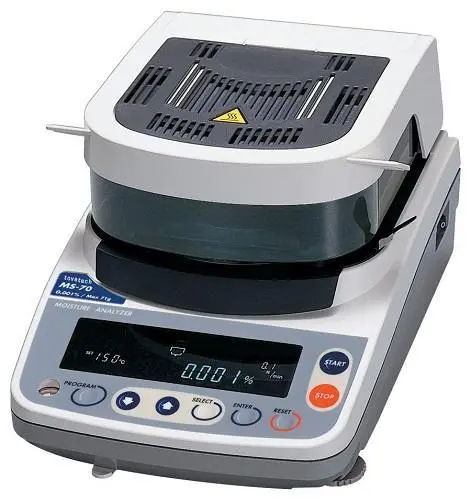
Precision moisture content measurement with easy operation and fast, accurate results. Our curated selection of halogen and infrared benchtop moisture analyzers ensures quality control and regulatory compliance. Whether you're measuring moisture in resins, food products, grains, wood pellets, or pharmaceuticals, we have the right instrument for your QC requirements.
Incorrect
moisture content affects shelf life, appearance, processability, and
structural integrity. Moisture analyzers ensure products meet
specifications before packaging.
Regulatory
Compliance
FDA and
other government agencies mandate precise moisture measurement for
pharmaceuticals and food products. Documentation enables compliance
audits.
Cost
Control
Many
products are sold by weight. Too little moisture means delivering more
product than the customer paid for (loss of profit). Too much moisture
means delivering less product than the customer paid for
(liability).
Industry-Specific
Solutions
Start
with your sample behavior, expected moisture range, and the level of method
control you need. These recommendations help narrow the best-fit instrument
for routine QC, incoming inspection, and process troubleshooting.
Why Use a Moisture Balance
Moisture balances produce results with speed and accuracy for a broad
range of sample types. They operate based on the thermogravimetric
method: loss of weight on drying. The analysis is complete in minutes, as
opposed to hours using a drying oven.
Moisture balances are easy and user-friendly. Unlike Karl-Fischer
titration, a moisture balance does not require a skilled operator and no
harmful waste is produced.
Products being dried can be sampled and tested rapidly, allowing
technicians to determine when the drying process is complete.
Why Choose a Tovatech Moisture Analyzer
Moisture analyzers from Tovatech are reliable, easy to use, durable, and
give reproducible results.
Depending on the model they offer intuitive graphic displays, step by
step user guidance, and software to assist in setting method parameters.
Some models have memory for 20 programs for quick recall when testing a
variety of materials.
Models with a resolution of 0.001 g are suitable for QC testing of food,
beverages, wood, paper, sewage sludge, biofuel, and cosmetics. Choose a
model with a resolution of 0.0001 g for testing very low moisture
materials such as plastic resins, down to 0.02% moisture.
Plastics
& Resins
Companies
striving to deliver superior quality injected molded products are aware
that the moisture content of their resin feed is absolutely critical to
product quality.
Moisture content in your plastic resin feed affects product
quality:
Moisture content above the recommended percentage may deliver a part that "looks good" but can easily break or otherwise fail.
Continued heating after reaching the recommended moisture content will degrade the resins. This can lead to dull and brittle parts.
The Kern DLB 160-3Amoisture
analyzer is easy to use and offers an economical choice for QC testing
in food labs, food processing lines and harvested grains. It offers
users a choice of Standard or Rapid drying profiles. The DLB 160-3A is
shipped with a protective working cover and 10 sample plates.
For
testing samples with <0.5% moisture, contact Tovatech for help selecting the
right model.
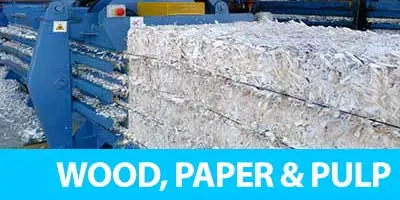
Wood,
Paper & Pulp
Kern DLB 160-3A halogen
moisture analyzers are very easy to use and offer an economical choice
for QC testing of moisture in many types of samples, offering a choice
of Standard or Rapid drying profiles. The DLB 160-3A is shipped with a
protective working cover and 10 sample plates.
For
testing samples with <0.5% moisture, contact Tovatech for help selecting the
right model.
How a Moisture Analyzer Works
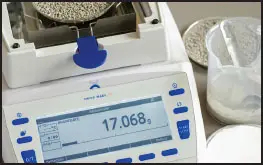
User interface
Precise measurement of moisture content - and documenting the findings -
is a quality control step often mandated by government agencies such as
the FDA and by trade and professional associations. Precisely determining
moisture content is accomplished by analyzing small samples, usually
measured in grams, in an instrument called a moisture analyzer.
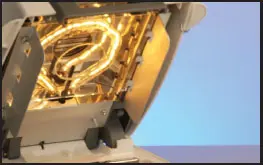
Heater options
The Moisture Analysis Process
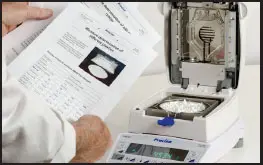
Moisture analyzers, also called moisture balances, such as the models
offered by Tovatech operate on the thermogravimetric method, a fancy word
meaning loss of weight on (heated) drying, abbreviated as LOD. Simply
stated, they calculate the before and after weight with the difference
denoting the sample's moisture content.
Moisture balances consist of two critical components. The first is a
precision balance, the second is a source of heat usually supplied by an
accompanying halogen or infrared heater.
Moisture analyzers can be programmed to conduct analyses according to
standard protocols, and can also be programmed with procedures developed
in QC or product development labs.
Moisture analyzer programming parameters include recommended sample
weight, drying time, drying temperatures and how the heat is applied,
called the drying profile. The drying profile is governed by the
particular characteristics of the sample.
Moisture Analyzer Drying Profiles
Moisture analyzers offered by Tovatech allow users to set drying profiles
to accommodate the types of substances being analyzed. Here’s a summary
of four basic drying profiles:
The most commonly used mode and suitable for most substances is
standard drying.
Samples that do not tolerate the full power of the halogen heater
should be analyzed using the soft or gentle drying mode. This helps
protect sensitive samples from decomposing or forming a protective
“skin.” In the soft drying mode samples are heated evenly from the
outside to the inside by heat convection.
For samples with moisture content between 5% and 15% fast drying
should be selected. This setting quickly raises the temperature to
approximately 40% above the set temperature (called preheat) to rapidly
drive off the bulk of the moisture and then returns it to the set
temperature to approach the end point slowly.
Samples with more than 15% moisture call for step drying.
Programmable methods
In Summary
A moisture analyzer is a precision instrument that requires trained
personnel to input an analysis method. A major advantage of a moisture
analyzer is that once the analysis method is programmed, the technician
needs minimal training and expertise to test samples and obtain
reproducible results.
Tovatech offers a range of laboratory moisture analyzers with halogen and
infrared heaters, and is prepared to provide assistance in selecting and
using them in your laboratory or quality control department. Contact our scientists for unbiased advice.
Frequently Asked Questions
Which moisture analyzer is good for plastic resin?
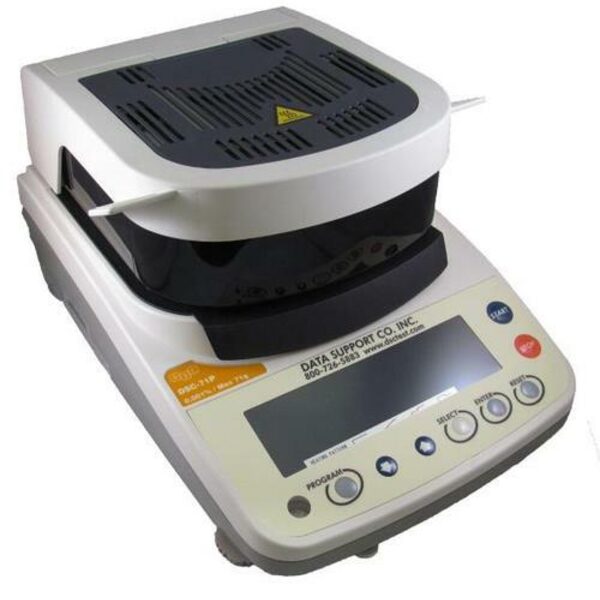
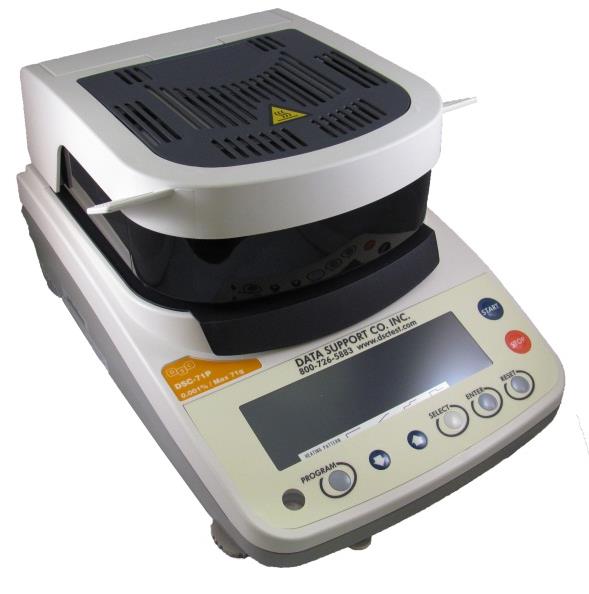
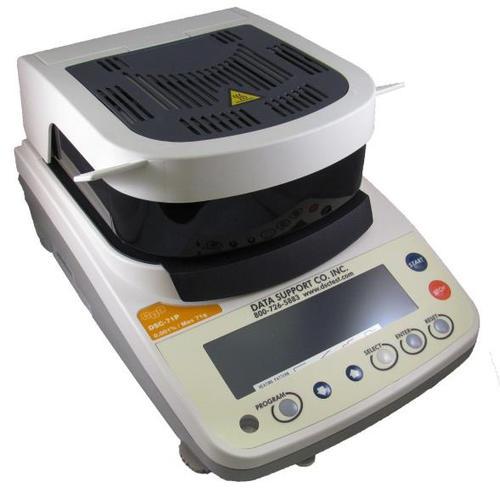
The DSC71P is outstanding for plastic resins. It measures moisture at
the high resolution required for low-moisture samples, produces results
comparable to the Karl Fischer method, requires no special knowledge or
training, and produces no harmful waste.
How fast can a moisture analyzer deliver results?
Most samples are completed in minutes, depending on moisture level and
the selected drying profile.
Do I need to calibrate the analyzer regularly?
Yes. Regular calibration helps maintain measurement accuracy and
supports consistent quality control records.
Which drying profile should I start with?
Start with Standard drying, then adjust to Soft, Fast, or Step profiles
based on sample behavior and repeatability targets.
What is the difference between a moisture analyzer and a moisture
meter?
A moisture meter gives quick, qualitative readings of water content
using electrical resistance or capacitance. It is suitable for instant
on-site measurements of estimated moisture in concrete or wood, but not
for plastics. A moisture analyzer is a precise laboratory instrument
that uses heat and weight loss to deliver accurate, quantitative
moisture percentages.
What is the ASTM method for moisture analysis of
plastics?
ASTM D6980 is the
"Standard Test Method for Determination of Moisture in Plastics by Loss in Weight."
Using a halogen moisture analyzer is an ASTM-recognized method.
How long do halogen lamps last?
About 5,000 hours. If you use a halogen lamp for 8 hours a day, its
lifetime is about 2 years.
Resources & Downloads
Need help selecting the right moisture analyzer?
Tell us your sample type, industry, and moisture range requirements. We'll match you with the right instrument and method.