

Specialized equipment and operating procedures come into play when ultrasonic cleaners employ flammable solvents to achieve mandated cleaning standards. Here is why flammable solvents are used, the risks involved, and options to mitigate risks.
Ultrasonic Cleaning with Flammable Solvents: What you Need to Know
While most ultrasonic cleaning challenges are solved with biodegradable water-based solutions, there are many occasions where ultrasonic cleaning with flammable solvents yields desired or required results. Commonly used flammable solvents for ultrasonic cleaning are acetone, toluene and IPA (isopropyl alcohol). Representative applications include:
- Manufacture of orthopedic implants, surgical and medical instruments
- Removing adhesives and paint from spray gun nozzles
- Cleaning X-ray tube components
- Cleaning sensitive electronic components
- Removing ink residues from printing equipment
- When residue-free results are required without rinsing
Risks Using Flammable Solvents in an Ultrasonic Cleaner
Because of their flash points and vapor densities (see below) flammable solvents create what the National Fire Protection Association terms a Hazardous Area.
This is an area with a risk of fire or explosion or a degree of hazard greater than the normal building occupancy. The locations are defined through the National Electrical Code (NEC) / NFPA 70 and specialized standards like NFPA 497 and 499.
There are local and company-related regulations requiring compliance when solvent cleaning with an ultrasonic cleaner.
Ultrasonic cleaner equipment and operating procedures help meet these requirements and are linked at the conclusion of this post. But first, here is What you Need to Know:
Defining Flammable Solvent Flash Points and Vapor Densities
A flash point is the temperature at which a particular organic compound gives off sufficient vapor to ignite in air when given an ignition source. An ignition source can be anything in the area that can create a spark, including the electronics used in an ultrasonic cleaner.
Vapor density is the weight of a gas or vapor compared to an equal volume of another gas – such as air at 1.0.
This means any vapor heavier than air will sink and spread throughout the area unless it is evacuated by a code-approved ventilating system (e.g. NFPA 91) above its source. Note that while all common organic solvent vapors are heavier than air, here are details on commonly used flammable solvents used in ultrasonic cleaning:
Characteristics of Commonly Used Flammable Solvents for Ultrasonic Cleaning
| Solvent | Flash Point | Vapor Density vs. Air at 1.0 |
|---|---|---|
| Acetone | -4⁰F (-20⁰C) | 2.0 |
| Toluene | 40⁰F (4.⁰C) | 3.14 |
| IPA | 53⁰F (12⁰C) | 2.1 |
Equipment Options for Ultrasonic Cleaning with Flammable Solvents
Tovatech offers two equipment options when your requirements include ultrasonic cleaning with flammable solvents. Both options require strict compliance with national and local safety standards.
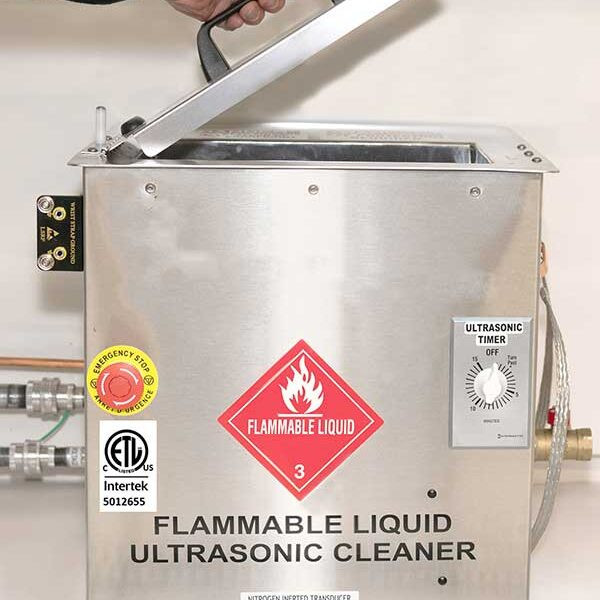
Explosion-Proof Ultrasonic Cleaners certified by a nationally recognized third party – the NRTL – used in conjunction with required safety procedures, are designed for large-part and micro-part cleaning.
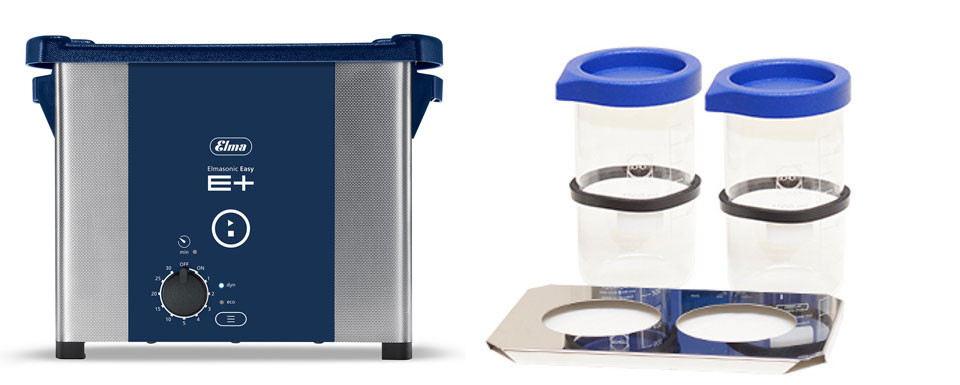
Bench-top cleaning small parts is accomplished using Ultrasonic Cleaner Beaker Kits designed to minimize the risk of solvent vapor exposure.
Have Questions? What to Do Next:
Check the product and application details on our explosion-proof and beaker kit options. Then contact the ultrasonic cleaning professionals at Tovatech for unbiased advice and more details on using flammable solvents to solve your ultrasonic cleaning challenges.