

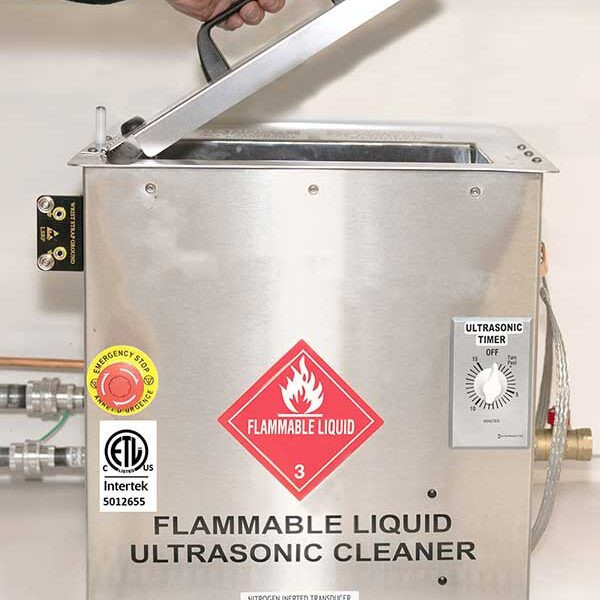
Code-approved equipment and operating procedures apply when parts-cleaning standards or cleaning results require the use of low flash point flammable solvents in an ultrasonic cleaner. This post provides ultrasonic cleaner equipment options and operating procedures that help you meet national, local and company-designated regulations when cleaning large parts and when cleaning micro-parts.
What’s an Explosion-Proof Ultrasonic Cleaner?
An explosion proof ultrasonic cleaner may be required to meet industry-specified cleaning standards or in order to meet customer-mandated cleaning results. Examples are found in the nearby table and links at the end of this post.
Instead of using water-based biodegradable chemistries, cleaning is accomplished using low flash point volatile solvents. A flash point is the temperature at which a particular organic compound gives off sufficient vapor to ignite in air when given an ignition source. An ignition source is anything in the immediate vicinity that causes a spark – including unprotected ultrasonic cleaner electronics.
Examples and flash points of commonly used solvents requiring an explosion-proof ultrasonic cleaner are isopropyl alcohol at 53⁰F, acetone at -4⁰F and toluene at 40⁰F. Other examples are found in The American Chemical Society’s table of common organic solvents.
Among other safety precautions, ultrasonic cleaners for low-flash-point solvents are designed and/or positioned to isolate their internal electronics from their solvent-containing tanks.
Applicable codes and standards may include the National Electrical Code (NEC / NFPA 70) for electrical equipment, NFPA 496 for purged and pressurized enclosures, UL 698A for industrial control panels for hazardous locations, along with NFPA 91 for exhaust systems and requirements imposed by the authority having jurisdiction (AHJ), the facility and company policy.
Typical Explosion-Proof Ultrasonic Cleaner Applications
- Medical instruments and surgical implants to assure residue-free results
- New and reconditioned stainless steel filters as part of passivation for corrosion resistance
- Traveling wave tubes, xenon ion propulsion systems, electronic power conditioners and microwave power modules at various stages of assembly
- Watch and micro-machined parts
- Medical and optical assemblies
- X-ray tube components for contamination-free results
- Remove solder flux and other contaminants to avoid manual-cleaning damage to PCBs
- Adhesive gun and spray- painting nozzles to assure quality coatings.
- Remove dry ink residues and contaminants from printing equipment.
Two Ultrasonic Cleaner Options for Flammable Solvents
This post provides two options using ultrasonic cleaners specifically designed for cleaning with volatile solvents. A third option, flammable solvent beaker kits, is covered in a separate post.
1. Cleaning large parts in an explosion-proof ultrasonic cleaner
For large scale operations a recommendation is the SOL XP flammable liquid ultrasonic cleaning system in 6 tank capacities from 2 to 33 gallons.
These 40 kHz tabletop systems use a remote electrical panel and generator, intrinsically safe tank circuits and a nitrogen-purged transducer enclosure. SOL XP models are available with customer-specified U.S. or Canadian ETL/Intertek certification.
The SOL XP should be situated in either a Class I, Division 1 hazardous-duty area or a suitable fume hood, with a customer-supplied ventilation system rated at a minimum of 650 CFM. A qualified facility or EHS professional must determine whether the hood, ventilation rate, electrical installation and area classification are suitable for the solvent and process.
SOL XP Industrial Solvent Ultrasonic Cleaner Features
- Remote electrical panels and generators positioned outside the CID1 area. (An explosion-proof purged panel is an option.)
- Cleaning tanks have nitrogen purged transducer enclosures and intrinsically safe circuits
- Optional cooling jackets capture vapor and reduce odor
- Optional solvent filtration systems prevent contaminant redeposition and extend solvent life
- Optional mesh baskets position parts at the proper level in the tank to maximize cleaning effectiveness
- Pro Tip on Equipment Sizing Ultrasonic cleaner models are generally designated by cleaning tank capacity in liquid volume. Two critical considerations are cleaning tank dimensions and cleaning basket dimensions. That is because desired cleaning results depend on proper placement of parts in the bath – unstacked and uncrowded – in baskets.
Basket dimensions are smaller than tank dimensions. For example, the 9-gallon SOLXP9 flammable liquid ultrasonic cleaner has tank dimensions 12 x 18 x 12 inches (DWH) with basket dimensions 11 x 17 x 6.5 inches.
- Key Point Have a clear idea of the size and configuration of the largest parts you will be cleaning before specifying your unit. Professionals know that it is better to run multiple cleaning cycles rather than stack or crowd parts in baskets if desired cleaning results are to be achieved.
Check this comprehensive product data sheet for full details on the SOL XP ultrasonic cleaner line designed for cleaning large parts with low flash point solvents.
2. Cleaning Micro Parts in an Explosion-Proof Ultrasonic Cleaner
Specially designed equipment is called for when volatile solvents are required for cleaning very small items. Examples include watch parts, contact lenses, micro-optics, medical device sub-assemblies and micro-machined parts that because of very small size or other requirements cannot be cleaned in ultrasonic beaker kits for flammable solvents.
In many instances, achieving completely residue-free results depend on multiple cleaning cycles at different ultrasonic frequencies along with oscillation, rinsing and drying steps.
An answer to these challenges can be found in the benchtop Elmasolvex VA Flammable Solvent Ultrasonic Cleaner for cleaning, rinsing and drying micro-parts.
This explosion proof ultrasonic cleaner is TÜV* safety-certified for use with solvents with a flash point ≥ 12°C (53⁰F). Examples for cleaning and rinsing include aliphatic C8-C11 hydrocarbons and C3 or higher alkyl compounds. Special solvent formulations are available for optimized cleaning.
*TÜV Rheinland is an internationally recognized test laboratory approved to test and certify products for workplace safety.
The Elmasolvex VA - Intrinsically Designed for Explosion-Proof Ultrasonic Cleaning
Cleaning is performed under reduced pressure in a sealed chamber. Vacuum technology enables cleaning, rinsing, and drying of difficult-to-access spaces. Explosion safety depends on the certified equipment design, monitored process, and permitted solvents. Installation in a well-ventilated area with outlets connected to exhaust tubes or an optional activated carbon unit protects operators from solvent vapor.
How the Elmasolvex VA System Works - In Brief
The microprocessor-controlled cleaning process employs pre-programmed cleaning steps and accepts additional programming entered by operators. For example, a cycle can employ cleaning and rinsing three times, all supported as required with oscillation, dual-frequency ultrasound at 40 kHz for cleaning and 80 kHz for rinsing. Operating modes include Normal, Sweep for uniformity and Pulse for tenacious contaminants. The procedure can also be programmed to use oscillation without ultrasound.
The drying cycle concludes the process.
- Reservoirs are filled with the desired cleaning and rinsing media
- Microparts are placed in fine-mesh baskets that are sealed in the unit’s cleaning, rinsing and drying chamber. Up to five baskets can be cleaned per cycle.
- Cleaning and rinsing media are drawn sequentially into the cleaning chamber using a vacuum from the media tanks positioned in the base of the unit.
- Cleaning and rinsing media are filtered and returned to their chambers for reuse.
Detailed information is contained in the Elmasolvex VA User Manual.
Educational Resources and Applications for Ultrasonic Cleaning
We hope this post helps you understand important points to consider when your ultrasonic cleaning requirements include the use of flammable solvents to achieve desired or mandated cleaning results.