

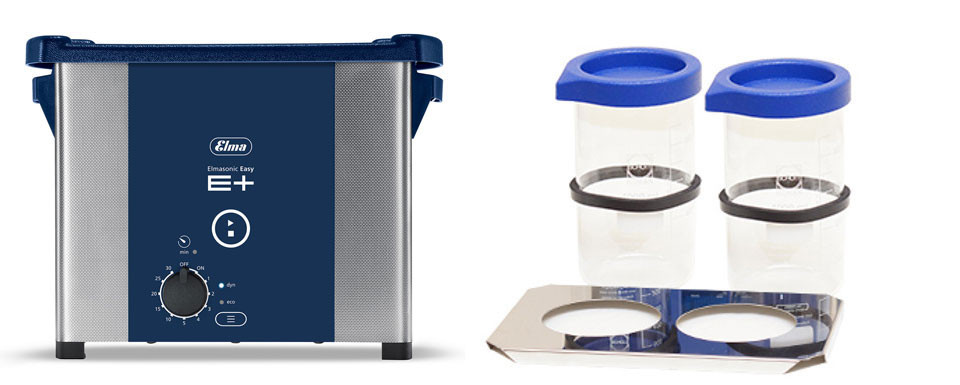
Using flammable solvents to ultrasonically clean small parts requires special precautions. Beaker kits isolate flammable solvents in covered beakers suspended in a water-filled ultrasonic cleaner tank. This, along with a code-approved ventilation system and other safety measures, reduces volatile vapors and ignition risks, and contributes to safe work areas.
National and local safety codes apply when industry standards or customer requirements specify ultrasonic cleaning using flammable solvents. These requirements come into play when conventional biodegradable cleaning solution formulations won't do the job.
While explosion-proof ultrasonic cleaners are available for large parts, here is how to sonically clean small parts in a flammable solvent beaker kit. But first:
The Safety Issue – Commonly used organic solvents used in ultrasonic cleaning have low flash points – that is the temperature at which vapors ignite if given an ignition source. Moreover, these solvents have a density heavier than air, which means vapors settle (See table). An ignition source can be anything in the area that can create a spark – including ultrasonic cleaner electronics.
Common Organic Solvents for Ultrasonic Cleaning
| Solvent | Flash Point | Vapor Density vs. Air at 1.0 |
|---|---|---|
|
Acetone |
-4⁰F (-20⁰C) |
2.0 |
|
Toluene |
40⁰F (4⁰C) |
3.14 |
|
IPA |
53⁰F (12⁰C) |
2.1 |
Note that more than these three solvents are used for cleaning purposes. Other examples include xylene, methyl ethyl ketone (MEK), industrial methylated spirits (IMS) and ethyl acetate. A more comprehensive listing, along with their flash points, is found in The American Chemical Society’s table of common organic solvents.
Relevant Safety Codes In addition to local and company codes, safety compliance is guided by the National Electric Code and National Fire Protection Association (NFPA). These address issues related to Class, Division and group, ventilation, and electrical concerns.
Ultrasonic Cleaning in Flammable Solvent Beaker Kits
There are correct procedures for using solvent cleaning in an ultrasonic cleaner. For small parts solvent cleaning the simplest and least costly approach is a benchtop flammable solvent beaker kit available from Tovatech.
The kits are offered in three models. Each contains the ultrasonic cleaner, beakers and caps in either 600 or 1000 ml capacity, beaker support rings and a two-holed lid to support the beakers in the tank. Optional fine mesh baskets sized to fit in the beakers can be used to contain very small parts.
The Process
Check your company’s environmental, health and safety (EHS) department to assure compliance when using beaker method ultrasonic cleaning. The same applies for local fire regulations for the maximum quantity of flammable solvent that may be treated in an open ultrasonic tank.
Situate the benchtop ultrasonic cleaner beaker kit in a well-ventilated area and ensure that flammable vapors cannot reach an ignitable concentration near the ultrasonic tank. Suggested guidance can be found in NFPA 91.
Preparation
Place the rubber rings on the beakers in such a way that the bottoms will be approximately 1-2 inches from the tank bottom when they are in the tank cover openings. Mark that position on the beakers for future use.
Add water and a few drops of dish detergent to the tank fill line.
Add enough solvent to the beakers to fully immerse parts to be cleaned. Do not add the parts at this time. Loosely cover the beakers and position them in the tank cover openings.
Activate the unit for about 10 minutes to degas the water solution and solvent. Use the degas mode if the unit is so equipped. Degassing removes trapped air that impedes the cleaning process.
When you are Ready to Clean
Add parts to the beakers, ensuring they are fully immersed, and loosely recover the beakers.
Activate the ultrasound. Cleaning action penetrates the beaker walls and acts on the contents. With experience you’ll establish optimum cleaning times and can use the unit’s timer for an auto-shutoff.
At the end of the cycle decant the solvent into a sealable container for reuse or for disposal according to local regulations. Because most solvents rapidly evaporate there may be no need to rinse and dry the cleaned products unless your procedures call for it.
Ultrasonic Beaker Kit Maintenance
Solvents will increasingly contain contaminants and should be discarded, following local regulations, when they lose their effectiveness. You can continue using the water bath but always check the level. If it becomes dirty, empty and clean the tank, refill and degas – along with fresh solvents.
Download our Beaker Kit Data Sheet for detailed product information and pricing.
Other Options for Ultrasonic Cleaning with Flammable Solvents
This post focuses on ultrasonic cleaning small parts in a system that minimizes risk but is not certified to be explosion proof. Some safety departments require an explosion proof unit when cleaning with flammable solvent in an ultrasonic cleaner.
Extremely small parts such as watch movements, contact lenses, micro-optics, medical device sub-assemblies and micro-machined parts can be cleaned, rinsed and vacuum-dried in the benchtop Elmasolvex VA Flammable Solvent Ultrasonic Cleaner. Parts emerge from user-programmable cycles completely residue-free.
This flammable solvent ultrasonic cleaner is NRTL (National Recognized Testing Laboratory) certified when used with solvents with a flash point ≥ 53⁰F (≥ 12⁰C).
Cleaning Large Parts with Flammable Solvents
When requirements call for cleaning large parts with flammable solvents, explosion-proof ultrasonic cleaners are specified. Unlike conventional industrial and benchtop ultrasonic cleaners, these units have their electronics located remotely.
The SOL XP flammable liquid ultrasonic cleaning system is offered in 6 tank capacities from 2 to 33 gallons. They are compliant with all Class I, Division 1 (CID1) code and zone requirements and are shipped with an Intertek ETL Certification.
Additional Resources on Ultrasonic Cleaning
Ultrasonic Cleaning Features and Benefits
A Resource on Cleaning with Flammable Solvents
Selecting an Explosion Proof Ultrasonic Cleaner
A Case Study on Solvent Ultrasonic Cleaning
Ultrasonic Cleaning with Flammable Solvents: What you Need to Know
How to Select an Explosion-Proof Ultrasonic Cleaner
Flammable Solvent Ultrasonic Cleaning: What to Do Next
The scientists at Tovatech have years of experience in helping folks like you make the correct equipment and operating decisions when your requirements call for selecting and using explosion-proof ultrasonic cleaners. Please contact us for professional and unbiased advice.