

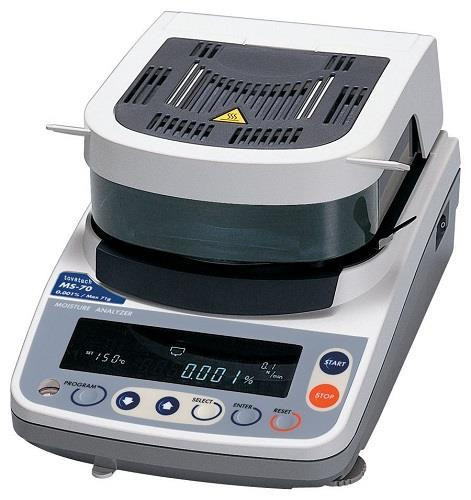
If you are shopping for a moisture analyzer and feel stymied by the number of choices, these moisture analyzer selection tips should help.
Moisture balance selection criteria are based on factors including:
- Resolution or the smallest difference that can be read on the display. This is also termed readability or readout.
- Repeatability - the ability of a moisture balance to display the same result when the same sample is tested repeatedly. Expressed as a standard deviation.
- Features important to performing moisture analysis. These are based on the characteristics of product being analyzed such as those require special heating profiles.
- Specialized capabilities such as testing products with extremely low moisture content specs, providing graphic displays of changing moisture content, and building libraries of frequently performed tests.
Four Candidate Moisture Analyzers
Tovatech offers several models of moisture analyzers from which researchers or QC personnel can select the most cost-effective solution to their needs. Following is a brief description of four of them. More information on these and other moisture balance products can be found on our website by browsing the available models here.
IL 50.01 – Economical choice for samples with >1% moisture
The 50-gram capacity IL 50.01 moisture balance provides 0.01g and 0.1% moisture readout over a moisture content range from 0.1 to 100% and repeatability of about 0.2% for 10g samples. The display shows % moisture, % solids, time and temperature. It has a temperature range of 50⁰ to 180⁰C in increments of 1⁰; comes with a 50g calibration weight and a carrying case. Data are transferrable to optional computers or printers using an RS 232 interface. Choose this moisture analyzer for samples with greater than 1% moisture content.
IL 50.001 – Quick and easy QC testing of samples with >0.3% moisture
Higher resolution is provided by the 50-gram IL 50.001 moisture analyzer: 0.001g or 0.01%. This unit otherwise has the same features as the IL 50.01 model. This model is an excellent and easy-to-use QC tool for samples with more than 0.3% moisture.
XM 60 – Versatility to test wide range of material types with >0.01% moisture
Multiple heating profiles are provided by the XM 60 moisture balance. Profiles are classified as standard drying which is the most common process and is suitable for most substances; soft-drying when samples form a surface film when heated too fast; and boost heating for samples with moisture content between 5% and 15%. This makes the XM 60 a good candidate if you test a variety of products. It has a 124g capacity, a resolution of 0.001g or 0.01% moisture, and a repeatability of 0.02% with a 10g sample. Its temperature range is 30⁰ to 230⁰C and its library can be programmed for 20 complete drying processes.
MS-70 – High resolution model for testing low moisture samples
Analyzing products with extremely low moisture content specifications should be done on the MS-70 moisture balance with a resolution to 0.0001g or 0.001% moisture content. It handles samples to 71g and provides a drying temperature range from 30⁰ to 200⁰C in increments of 1⁰. The MS-70 conforms to GLP, GMP and ISO protocols, provides 4 drying profiles, comes with software that delivers a real-time graphic display of the moisture loss rate on your computer, and stores 20 sets of moisture measurement conditions for easy recall.
View our additional blog post for a more detailed report on using a moisture analyzer.
Feel free to contact the scientists at Tovatech for advice on selecting a model and establishing procedures for your moisture analysis requirements.